Blog

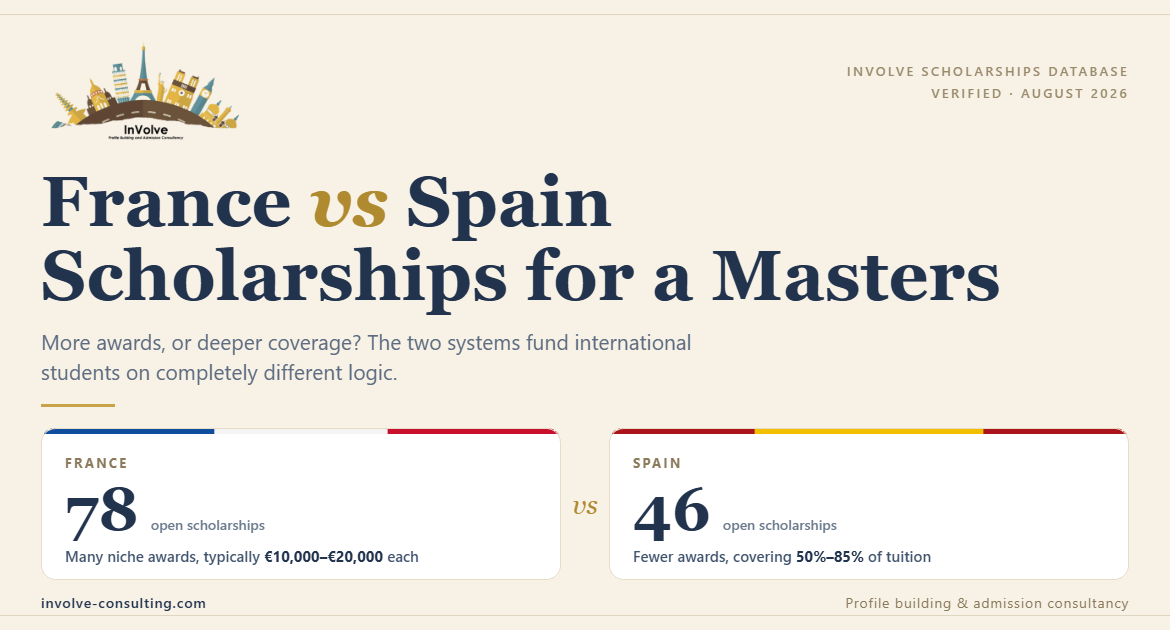
France 78 open scholarships versus Spain 46 open scholarships for international Masters students
France vs Spain: Where Masters Scholarship Money Goes Further
France vs Spain: Where Masters Scholarship Money Goes Further 1024 538 Involve Consulting

Most international students size up Paris and Madrid on rent, cafés and post-study visa rules. The bigger financial gap sits somewhere less obvious: institutional aid.

Our 16 August 2026 export from the Involve Scholarships database shows 78 open scholarships for international business students in France, against 46 in Spain. Read quickly, 78 versus 46 makes France the obvious winner. Read properly, it does not. France hands out a lot of mid-sized, tightly defined awards. Spain hands out fewer, and several of them wipe out most of a tuition bill. Which country stretches your money further depends on whether your profile is unusual or your financial need is documented.

Don’t judge a country by its sticker price

Applicants to a Masters in Management or an MSc usually compare tuition and cost of living, notice that a room in Barcelona costs less than one in the 6th arrondissement, and conclude that Spain is the cheaper degree. That comparison misses where the real money moves.

As an international student, your funding options are narrow. The subsidised state loans local EU students use are not open to you. You are left with savings, a private international student loan at an unfriendly rate, or a scholarship from the school itself. Scholarships are the only one of those you never pay back, so the way French and Spanish institutions hand out grants will shape your final cost far more than the price of a metro pass.

The point is not that business school is expensive. It is that the two countries discount tuition on different logic. Apply into a system that is not built for your profile and you leave several thousand euros behind.

Some systems spread aid thinly across many students to build a mixed classroom. Others concentrate endowment money into a handful of large grants aimed at candidates who genuinely cannot pay. Knowing which one you are applying into is how you predict your actual outlay.

France: many awards, each with a ceiling

France simply has more grants available. Across those 78 verified open scholarships, French business schools have spent the past two decades building narrow funding pools rather than a few large general ones.

The goal is a cohort that reads like a UN General Assembly: every professional background, every nationality, every gender. To get there, schools carve out separate awards for candidates from specific emerging markets, for women moving into finance, for people arriving from industries that rarely send anyone to business school, and for particular leadership profiles. The average award is a fixed sum rather than a full ride, but if your background is distinct, your odds of landing at least one of them are good.

The INSEAD Diversity Fund Scholarships are a fair example. INSEAD uses the fund to keep a wide mix of nationalities and career histories in each intake, and it pays a partial tuition grant of €10,000 to €20,000. The deadline is 22 October 2026.

Sciences Po’s Émile Boutmy Scholarship works the same way for Masters candidates from outside the European Union, offering an €18,500 tuition exemption. That one closes on 19 October 2026.

Neither covers the full cost of attendance. Both give you a predictable, fixed discount that brings the degree within reach for a targeted set of international profiles.

Worth knowing: the Émile Boutmy Scholarship is aimed squarely at strong non-EU applicants, which makes its €18,500 exemption one of the largest single non-EU awards currently open anywhere in the French system.

Spain: fewer awards, but they go deep

Spain runs the opposite play. Its 46 verified open scholarships are fewer in number, and considerably heavier per student. Spanish business schools tend to pool their aid into broader categories and weight demonstrable financial need alongside academic record.

Rather than fifty separate €10,000 awards tied to nationality or industry, Spanish institutions are more likely to fund a large percentage of your tuition bill outright. Win one and the effect on your finances is not incremental. The catch is that you are competing in a smaller, more general pool, which makes the initial decision harder to win.

Esade Business School shows the model clearly. Instead of capping aid at a flat euro figure, it ties the award to the cost of the programme. The Esade MSc Need-based Scholarships cover between 50% and 85% of total tuition fees. The exact deadline for that MSc grant is not published, but the structure is a permanent feature of how the school funds students, not a one-off call.

The same applies on the MBA side, where the Esade Need-based Scholarships for the Full Time MBA also run at 50% to 85% of tuition during the 2026-2027 call. On a €70,000 bill, an 85% award does more for your debt than two French diversity grants stacked together.

Reading the two systems side by side

France Spain
Open scholarships (Aug 2026) 78 46
Typical structure Fixed euro amount Percentage of tuition
Award logic Diversity and profile fit Financial need plus merit
Typical range €10,000 – €20,000 50% – 85% of tuition
Odds vs. size Better odds, smaller cheques Longer odds, bigger cheques
Best suited to A distinctive or underrepresented profile Documented need with strong academics

So which one suits you

You cannot decide this on a general sense of which country feels cheaper. It comes down to one honest question: is your background unusual, or is your need documented?

If you come from an underrepresented region, hold a demographic profile schools are actively recruiting, or work in an industry that rarely feeds into a Masters in Management, France will usually stretch further. With 78 awards in circulation, you can aim at the specific pots built for someone like you. You are playing the odds, and the odds are decent, because French schools have already earmarked money to make sure a candidate with your profile is sitting in the room.

If your background is more conventional but you can evidence real financial need alongside strong academic results, Spain will usually stretch further. There is no niche fund to hunt for. You apply straight into the broad need-based grants at schools like Esade and aim at that 50% to 85% reduction. You are playing for depth, backed by a system that heavily subsidises a small number of candidates who cannot meet the sticker price.

Stop guessing which country is more affordable. Look at your CV, look at your bank statement, and match the two against how each country actually hands out money.


If you would rather build a funding strategy than guess at one, Involve Consulting can help. We work with international applicants to pin down the programmes and institutional grants that fit their professional background and their financial reality. Tell us about your profile at involve-consulting.com/contact-us.

To see the deadlines, coverage and eligibility behind all 124 scholarships across France and Spain, browse the verified database at scholarships.involve-consulting.com.

Canada Funds 19 Scholarships for International Students Nobody Talks About
Canada Funds 19 Scholarships for International Students Nobody Talks About 1024 538 Involve Consulting

If you’re an international student planning to study in Canada, you’ve probably heard that funding is scarce and mostly reserved for domestic applicants. That’s simply not true. A quick search through the Involve Scholarships verified database reveals exactly 19 distinct, high-value scholarships available to international students studying in Canada right now. The real problem isn’t a lack of money. It’s a lack of visibility. Most applicants only look at university-specific entrance awards and completely miss massive federal, provincial, and private grants. Here’s how to find and secure the Canadian funding everyone else is ignoring.

The Hidden Market of Canadian International Funding

The myth that Canada doesn’t fund international students comes from a misunderstanding of how Canadian higher education financing actually works. When most international applicants start looking for money, they go straight to the financial aid page of the specific university they want to attend. They look for entrance scholarships, international student bursaries, or departmental grants.

Relying solely on university websites creates a massive blind spot. University-administered entrance scholarships for international students are highly competitive and often quite small, frequently ranging from $2,000 to $5,000. They’re designed to act as a tuition discount to attract talent, not to fully fund your life and research. Because these small awards are the only ones heavily advertised by the schools themselves, applicants assume this is the absolute ceiling for international funding.

Meanwhile, the largest pools of money sit completely outside the university system. The Canadian federal government, provincial governments, and private organizations run their own massive funding apparatuses. These external agencies want to bring top-tier global talent into the Canadian economy and research ecosystem. They offer grants that can cover full tuition and living stipends for multiple years.

However, these external awards require separate applications, entirely different eligibility criteria, and deadlines that operate on a completely different calendar than your university admission applications. Because the process feels fragmented and requires proactive research, the vast majority of international students simply don’t apply. They assume that “federal” or “provincial” automatically means “citizens and permanent residents only.” While that restriction applies to some specific grants, many of the most lucrative awards have specific tiers carved out explicitly for international talent. By ignoring the external funding market, you’re leaving tens of thousands of dollars on the table.

Five Major Canadian Awards You Should Be Targeting

To prove how substantial this hidden funding market is, we can look at five specific awards currently open to international students. These range from massive government research grants to private organizational funding, all with deadlines approaching this fall and winter.

The Canada Postdoctoral Research Award (CPRA) is a prime example of high-level federal funding aimed at bringing global expertise into Canadian institutions. This award provides $70,000 per year for up to 24 months. That’s $140,000 in total funding for an international researcher. The application requires a detailed research proposal and a confirmed affiliation with a Canadian host institution. Because the deadline is September 10, 2026, applicants must spend the summer coordinating with their prospective Canadian supervisors to build a compelling case for their research impact.

At the provincial level, Quebec offers some of the most aggressive funding for international students in the country. The FRQ Bourses de doctorat en recherche 2027-2028 provides $25,000 per year to support doctoral students. The Fonds de recherche du Québec (FRQ) specifically uses this money to attract top academic talent to the province’s universities. The deadline for this cycle is September 29, 2026. Applicants need to demonstrate a strong academic track record and a research project that aligns with the strategic interests of the province.

For doctoral students looking outside of Quebec, the federal government offers the Canada Graduate Research Scholarship – Doctoral (CGRS D). This is one of the most prestigious awards available, offering $40,000 per year for up to 36 months. Securing $120,000 in guaranteed funding completely changes the trajectory of a doctoral degree, allowing a student to focus entirely on their research rather than scrambling for teaching assistantships. The deadline for the CGRS D is October 17, 2026.

Private and organizational funding also plays a large role in the Canadian landscape. The P.E.O. International Peace Scholarship is designed specifically for women from other countries who are pursuing graduate study in the United States or Canada. The scholarship provides a maximum of $12,500 and requires the applicant to demonstrate a commitment to making a global impact or returning to their home country to enact positive change. The deadline for this award is December 15, 2026.

Finally, private lenders and financial organizations offer accessible sweepstakes and essay-based awards. The MPOWER Global Citizen Scholarship is open to international students at supported Canadian institutions, offering awards ranging from $1,000 to $8,000. The deadline is December 31, 2026. While smaller than the massive federal grants, these private scholarships are excellent tools for closing small funding gaps, covering textbook costs, or paying for initial relocation expenses.

Did you know: The Fonds de recherche du Québec (FRQ) explicitly removed the Canadian citizenship requirement for its core doctoral research scholarships in recent years, opening millions of dollars in provincial funding directly to international students studying at Quebec universities.

How to Build Your Fall Application Timeline

The biggest mistake international students make with Canadian funding is waiting until they have an acceptance letter in hand before they start looking for money. If you look closely at the deadlines for the major awards listed above, a clear and urgent pattern emerges.

The largest, most lucrative government and research awards happen earliest in the cycle. The CPRA closes on September 10. The FRQ doctoral awards close on September 29. The federal CGRS D closes on October 17. These deadlines occur a full year before the actual academic program begins. If you wait until you receive a university admission offer in March or April of 2027 to start looking for funding, the deadlines for $40,000-per-year federal grants will have been closed for six months.

You must apply for these external scholarships concurrently with your university applications. If you’re reading this in late August, your immediate priority must be finalizing your research proposals and securing your reference letters for the September and October government deadlines. These applications require rigorous academic writing and clear alignment with Canadian research priorities.

Once the heavy government applications are submitted in October, you can shift your focus to the private and organizational awards. The P.E.O. International Peace Scholarship and the MPOWER Global Citizen Scholarship have deadlines in mid-to-late December. This gives you November and early December to tailor your personal essays for these private organizations, which tend to focus more on your personal narrative, your leadership potential, and your global impact rather than strict academic research metrics.

Treat funding as a parallel admissions process. You’re not just applying to a Canadian university. You’re applying to the Canadian government, to provincial bodies, and to private trusts. By mapping out these deadlines now and treating the external funding market with the same seriousness as your university applications, you drastically increase your chances of securing a fully funded education.

If you need help structuring your graduate applications or refining your research proposals to compete for these top-tier Canadian awards, — get in touch with our team to explore our advising programs. Browse more verified scholarships here.

UK vs Germany: Which Country Funds More MBAs?
UK vs Germany: Which Country Funds More MBAs? 1024 538 Involve Consulting

The United Kingdom has 118 verified MBA scholarships in our database, while Germany has 86. But that raw count doesn’t tell the whole story. The UK offers more university-backed partial tuition waivers and government fellowships. Germany, however, makes up for fewer scholarships with much lower tuition costs and a system of political foundation stipends that cover living expenses. If you’re choosing where to apply based on funding, you need to look beyond the total number of awards and understand how each country structures its financial aid.

The Real Cost of a European MBA

When candidates consider European business schools, the UK and Germany are almost always top choices. The UK has historic institutions and a large financial sector in London. Germany offers a strong manufacturing economy, a growing tech scene in Berlin, and favorable post-study work visas. But when you calculate the return on investment, funding quickly becomes the main topic.

Many applicants assume the funding strategy is the same for both countries. They plan to apply to business school, check the financial aid box, and hope for a large tuition reduction. This approach misunderstands how European MBA funding works. In the United States, business schools often use large endowments to offer full-tuition fellowships to attract top candidates. In Europe, funding is decentralized. You’re rarely looking for one check that covers everything. Instead, you’re trying to put together a mix of partial tuition waivers from the university and external stipends from government bodies or private foundations.

The problem candidates face isn’t a lack of money, but a lack of clarity about where that money is and what it covers. If you only look at the surface, you might think one country is much better than the other based on a simple tally. To make an informed decision, you need to understand how a UK university discounts tuition compared to how a German political foundation funds your rent. Without that distinction, you risk missing out on tens of thousands of euros or pounds just because you missed a deadline or applied to the wrong type of organization.

Breaking Down the UK’s 118 Scholarships

The UK currently leads in the number of verified MBA scholarships, with 118. This high volume comes from a competitive, market-driven higher education sector. UK business schools actively compete for top international talent and use partial tuition scholarships as their main recruitment tool.

When you apply to a UK program, you’ll find many university-specific awards. For example, the Strathclyde FT MBA 60th Anniversary Scholarships, offered directly by the University of Strathclyde Business School, provide partial tuition coverage, reducing the initial invoice from the university. The deadline for this award is August 31, 2026. Because business schools manage these awards internally, the application process is usually integrated with or closely follows your main program application.

However, partial tuition coverage doesn’t pay your rent in London or Glasgow. To cover living expenses, UK applicants must look to external government and commonwealth funds. The Commonwealth Scholarship Commission in the UK (CSC) is a major player here. They offer specific, stipend-only awards designed to cover daily living costs rather than tuition. For instance, the CSC offers Commonwealth Fellowships (Professional and Academic Fellowships) with a deadline of August 25, 2026. They also offer Commonwealth Startup Fellowships, which have a similar stipend-only structure but a deadline of September 1, 2026.

The practical advice for the UK is that you must run two parallel funding campaigns. You need to negotiate with the business school’s admissions committee for partial tuition waivers while also presenting your long-term career vision to external bodies like the CSC to secure your living stipend.

Decoding Germany’s 86 Scholarships

Germany has a completely different financial system. We currently track 86 verified MBA scholarships for Germany. While this is a lower number than the UK, the context of German higher education makes these 86 awards very impactful.

First, the baseline cost of education in Germany is generally lower. Even at private German business schools, tuition rarely reaches the high amounts seen in London or the US. Therefore, the main financial hurdle for international students in Germany isn’t always the tuition itself, but the strict visa requirement to prove you can support yourself. The German government requires international students to deposit a set amount of money into a blocked account to guarantee they can cover their monthly living expenses.

This is where Germany’s unique system of external foundations becomes important. Much of the funding in Germany comes from these politically or socially affiliated organizations rather than the business schools themselves. These foundations support candidates who align with their specific values, and they almost exclusively offer stipend-only awards designed to cover your living costs.

The Heinrich-Böll-Stiftung is a good example of this system. They manage multiple, targeted funds. For example, they offer the Heinrich Böll Foundation Scholarship for International Master’s Students, a stipend-only award with a deadline of September 1, 2026. The Heinrich Böll Foundation also runs a separate Student Scholarship, another stipend-only program with the same September 1, 2026 deadline.

Did you know: The Heinrich Böll Foundation offers multiple distinct stipend-only scholarships for international students, such as their specific award for International Master’s Students and their general Student Scholarship, both of which have deadlines falling on September 1, 2026.

To win funding in Germany, your strategy must move beyond purely academic or test-based arguments. German foundations want to see civic engagement, alignment with their ideological or social goals, and a clear plan for how your MBA will contribute to society. You’re not just convincing an admissions director that you’re smart; you’re convincing a foundation board that you’re a future leader who shares their worldview.

How to Choose Your Target Country Based on Funding

How do you use this information to choose between the UK and Germany? You have to calculate the net cost, factoring in the different types of available aid.

Don’t choose the UK simply because 118 is a larger number than 86. Instead, map out the actual cash flow. For a UK target school, find the total tuition and subtract a realistic partial tuition scholarship, like the one from Strathclyde. Then, calculate your living expenses and see if you’re eligible for a CSC stipend to offset them.

For a German target school, consider the generally lower tuition cost. Then, look at the blocked account requirement for your living expenses and identify at least three foundations where your personal volunteer work or career goals align with their mission. If you can secure a stipend-only award in Germany, the overall cost of your MBA can drop significantly, often making it more affordable than a heavily discounted UK program.

The deciding factor is rarely your test score alone. It’s your ability to match your specific profile to the right type of funding. If you have a strong corporate background and high test scores, you might excel at winning merit-based partial tuition waivers directly from UK business schools. If you have a strong track record of community leadership, environmental advocacy, or social entrepreneurship, you are very competitive for the foundation-backed living stipends in Germany.

Getting this right requires early planning and a clear understanding of what each scholarship committee wants to see. You need to track deadlines carefully, as missing an early September cutoff can cost you your entire living stipend for the year.

If you want to see the full range of what’s available in both countries, you can browse our complete, verified database of opportunities here. If you’re ready to stop guessing and want expert help building a targeted application strategy that maximizes your chances of securing these awards, we can help — reach out to our team to discuss your profile and find the right funding path for your MBA.

The Scholarship Application You’ll Never See: How University Nomination Actually Works
The Scholarship Application You’ll Never See: How University Nomination Actually Works 1024 538 Involve Consulting

Our verified database of Involve Scholarships, updated August 16, 2026, lists 67 major funding opportunities with a specific, often frustrating, characteristic: you can’t apply for them directly. If you send your essays, transcripts, and recommendation letters straight to the funding foundation, your application will be disqualified. To get one of these 67 awards, you first have to win a different competition: you need an official nomination from your current or former university.

This two-step system surprises thousands of qualified applicants every year. Students spend weeks researching a prestigious award, noting the official deadline on the foundation’s website, and planning their writing schedule. They don’t realize that the official deadline is only for the university to submit its chosen nominees. The internal campus deadline—the date by which you must prove to your school that you deserve their endorsement—passed months ago. Understanding how university nomination works is the only way to access this hidden layer of graduate funding.

The Hidden Mechanics of Institutional Endorsement

To understand why this system exists, consider it from the funding organizations’ perspective. Prestigious national and international foundations receive a huge amount of interest. If they accepted applications from everyone, they’d be overwhelmed by tens of thousands of submissions, many from candidates who don’t meet basic academic or leadership requirements.

To manage this volume and maintain quality, these organizations outsource the initial filtering to universities. By requiring institutional endorsement, the foundation makes the university do the hard work of vetting candidates. The foundation essentially tells universities they can only put forward a small number of their very best students.

For applicants, this creates a complex dual-deadline situation. You’re not just trying to impress a distant committee of readers. You first have to convince a local committee of faculty members and administrators on your own campus that you are the strongest candidate. If you don’t win over your campus committee, your journey ends before it begins. The foundation will never see your name.

Real Stakes and Rigid Deadlines

The awards that use this nomination structure are often among the most generous and prestigious globally. Because the financial stakes are so high, the internal competition is intense.

Take the Marshall Scholarship, funded by the Marshall Aid Commemoration Commission. This award covers all costs for students to study in the United Kingdom. The official external deadline for the current cycle is September 29, 2026. However, a university can’t just approve a student’s application and send it off on September 28. The campus committee needs significant time to review all interested students, read their preliminary essays, conduct mock interviews, select the final nominees, and then write a comprehensive institutional endorsement letter for each one. Because of this administrative work, a university’s internal deadline for the Marshall Scholarship is usually in late spring or early summer—well before the September deadline the commission posts.

The same applies to the awards from the Commonwealth Scholarship Commission in the UK. The external deadline for the Commonwealth Master’s Scholarships is October 20, 2026. This same October 20 deadline also applies to the Commonwealth PhD Scholarships, and the specific Commonwealth PhD Scholarships track for Least Developed Countries and Fragile States. All these awards cover everything, including tuition, airfare, and living stipends. If a student waits until October to start their paperwork, they’ve already missed their chance. The university’s internal selection board will have finalized its nominees weeks earlier.

Did you know: The Commonwealth Master’s Scholarships cover more than just tuition. The award also includes return airfare to the United Kingdom and a guaranteed living stipend of £1,712 per month.

Even domestic awards follow this strict timeline. The Harry S. Truman Scholarship, funded by the Harry S. Truman Scholarship Foundation in the United States, offers up to $30,000 towards graduate study. The official deadline is February 2, 2027. Yet, most universities require students to submit their internal applications by November or December of the previous year.

How to Win the Campus Competition

The reality of nomination-based scholarships is that you need to treat your own university as your first admissions board. You can’t approach this casually.

Your first step is to find the right contact. Most major universities have an office for this process, often called the Office of Distinguished Fellowships, the National Scholarships Office, or something similar. At smaller schools, a specific faculty member or the academic advising center might handle this role. You need to find out exactly who controls institutional endorsement and introduce yourself to them as early as possible.

When you make contact, you need to understand the university’s motivation. The fellowship office isn’t just an administrative hurdle; their job is to produce winners. When a university produces a Marshall or Truman scholar, it boosts the institution’s prestige, helps them recruit better faculty, and looks great in their marketing. The committee wants to support candidates who have a real chance of winning the national competition. You aren’t asking them for a favor. You are presenting yourself as a valuable asset for the school.

Because the campus committee wants you to win, they will often be your toughest critics. If you are selected as a nominee, the internal committee will likely scrutinize your application and make you rewrite your essays multiple times before the external deadline. You should welcome this. It’s a huge advantage. You get a team of experienced readers to refine your MBA/MiM admissions materials or graduate funding essays before the foundation ever sees them.

To succeed in this process, you must submit your internal application with the same level of polish you would use for the final foundation deadline. Don’t give your campus committee a rough draft and promise to improve it later. They are evaluating your current potential, and a sloppy internal application suggests you aren’t ready for the demands of a national selection process.

The Timeline Shift

The most important takeaway for any applicant targeting a nomination-based scholarship is the timeline shift. You must permanently change how you view deadlines.

Whenever you find a scholarship that requires university endorsement, look at the official deadline and immediately move your mental timeline back by at least two full months. If the foundation wants the application in October, your personal deadline is August. If the foundation wants it in February, your personal deadline is November.

Don’t guess when the internal deadline might be. The moment you identify an award you want to pursue, search your university’s website for their specific internal timeline. If you can’t find a clearly posted date, email the fellowship office that same day to ask. These contacts prefer early notice that you intend to apply, even if your materials aren’t finished. By reaching out early, you give the university time to guide you, and you ensure you never miss a major funding opportunity just because you were looking at the wrong calendar.

Navigating the hidden layers of graduate funding requires strategy, foresight, and a clear understanding of the rules. If you are planning your MBA/MiM admissions journey and want to build a comprehensive strategy for securing institutional endorsements and major funding, we can help you map out those critical early deadlines — reach out to our team to discuss your profile. To explore more verified funding opportunities and see exactly what is available for your target programs, browse the full database here.

INSEAD 2026–2027 Essays: A Question-by-Question Playbook
INSEAD 2026–2027 Essays: A Question-by-Question Playbook 500 263 Involve Consulting

You open the application portal expecting the usual business school format: a resume upload, a couple of data fields, and one all-purpose personal statement about your future goals. INSEAD’s 2026–2027 cycle — covering both the January 2027 and August 2027 intakes — doesn’t work that way. Instead you find four required essays split across two very different categories, plus one optional fifth, and a combined word budget of roughly 1,700 words before you’ve written a single line of your career goals paragraph.

That structure is not an accident. INSEAD isn’t asking for a list of your professional wins. It’s testing your rationale, your self-awareness, your resilience under pressure, and your readiness for a classroom built entirely on peer-to-peer learning across cultures. Treat the essays as one connected application and you’ll waste your best material in the wrong place. Treat each one as its own, narrow test — which is what this guide walks through — and you give the admissions committee exactly what it’s grading for, question by question.

What INSEAD Is Actually Testing, at a Glance

The application splits into two Job Description essays and two required Motivation essays, with an optional fifth essay reserved for anything the rest of your application didn’t cover.

Did you know: across the four required essays, INSEAD gives you a combined limit of just 1,700 words — barely three pages — to cover your entire career rationale, your goals, your character, and a genuine crisis. That tight budget is deliberate: it forces precision over padding, which is exactly what the admissions committee is screening for.

The Job Description essays are about logic: does your career make sense, and do you know exactly where INSEAD fits in it? The Motivation essays are about character: can you be honest about a weakness, and can you stay composed when things go wrong? Every paragraph you write should serve one of those two goals — never both at once, and never neither.

Essay 1 (Job Description, 500 words): Your Career Since Graduation

The question: Provide a summary of your career since graduating from university, explaining the rationale behind your key decisions and career progression. Include a description of your current or most recent role — its scope, major responsibilities, team size, budget, clients or products, and results achieved.

What INSEAD is looking for: This is not a chronological CV recap. The admissions committee already has your resume. What they’re grading here is whether each move you made had a reason behind it — and whether that reason shows judgment, not just opportunism. A career that reads as “promotion, then bigger promotion, then bigger title” tells them nothing about how you think. A career that reads as “I took this role because I wanted to learn X, then left because I’d outgrown it and needed Y” tells them everything.

How to structure it, paragraph by paragraph:

Open with a single sentence that frames your professional identity — not your job title, but the type of problem-solver you are. Keep it to one sentence; this essay has no room for a long preamble.

In your second paragraph, cover your first one or two career moves and the specific rationale behind each — what you wanted to learn, and why the previous role couldn’t teach it to you. This is where “rationale” earns its word count: name the gap you were closing, not just the opportunity you were taking.

Your third paragraph should isolate anything that made your path international or cross-functional — a relocation, a client base spanning multiple countries, a team you managed across time zones — and treat it as its own beat rather than folding it into the general narrative. INSEAD weighs international exposure heavily, and burying it inside a sentence about your job title wastes the signal.

Your fourth paragraph is the mechanical one: current role, scope of work, direct reports if any, budget or P&L responsibility, and the results you can quantify. Be specific and be brief — this is a checklist the committee is scanning for, not a place for story-telling.

Close with one sentence bridging to INSEAD — not a generic “and that’s why I want an MBA,” but a specific line about the kind of diversity in the classroom you’re seeking next, since that’s the thread this essay has been building toward.

“I joined a renewable-energy engineering firm because I wanted exposure to physical infrastructure, not just spreadsheets — a gap my first two years in corporate finance couldn’t close. Within eighteen months I was leading commissioning for a wind-farm project that put me on-site in Brazil for six months, coordinating with three subcontractor teams who didn’t share a first language, which is where I first learned that technical accuracy means nothing if your team doesn’t trust the person delivering it. Today I manage a four-person engineering pod and a $2.1M project budget, and I closed last year having cut commissioning delays by 30% across two sites. What I’m looking for next isn’t a bigger version of this role — it’s the chance to test that judgment against peers who’ve built very different careers.”

(Illustrative example, for structure only)

Essay 2 (Job Description, 300 words): Career Goals

The question: Describe your short- and long-term career aspirations, including your target geography, industry, and function. How do you plan to bridge the gap between your current position and these goals, and how will INSEAD help you achieve them?

What INSEAD is looking for: Specificity. Vague ambition (“I want to move into a leadership role in a dynamic industry”) reads as someone who hasn’t done the thinking yet. The committee wants a named function, a named industry, and ideally a named geography — and then proof you’ve actually researched how INSEAD’s own resources close the distance between where you are and where you’re going.

How to structure it, paragraph by paragraph:

Paragraph one: your short-term goal immediately after the MBA — name the function and industry precisely, and the type of company or role you’re targeting.

Paragraph two: your long-term vision, five to ten years out — this can be more directional, but it should still connect logically to the short-term step, not read as a separate ambition bolted on.

Paragraph three: the bridge. Name specific INSEAD electives, a club, an exchange campus, or a professor’s focus area that maps directly onto the gap in your profile. Generic praise for “the diverse network” is the single most common way applicants waste this paragraph — specificity here is what separates a researched answer from a template one.

“In the short term, I want to move from engineering execution into infrastructure investment strategy, joining a fund that finances renewable projects in emerging markets. Long term, I want to run that kind of fund’s regional practice, building the financing structures that let more of these projects get built in the first place. The gap between an engineer and an investor is largely a language one — I can build the asset, but I can’t yet underwrite it — which is exactly why I’d take Understanding and Managing Risk in my first period and look to spend an exchange period at a campus with a stronger infrastructure-finance elective bench.”

(Illustrative example, for structure only)

Essay 3 (Motivation, 500 words): A Candid Description of Yourself as a Person and a Leader

The question: Give a candid description of yourself as a person and a leader, stressing the personal characteristics you feel to be your strengths and weaknesses and the main factors that have influenced your personal development, giving examples where necessary.

What INSEAD is looking for: Genuine self-awareness, not a strengths list with a fake weakness bolted on. The classic failure here is naming a “weakness” that’s actually a humble-brag — “I work too hard” or “my standards are too high.” The committee has read that essay a thousand times, and it reads as someone unwilling to do the harder work of real reflection.

How to structure it, paragraph by paragraph:

Open with the personal characteristic that has shaped you most — ideally traced back to something concrete in your early life or background, stated in a sentence or two, not a full childhood story. This sets the theme the rest of the essay will develop.

Second paragraph: describe an environment or community — a team, a program, a group you belonged to — that shaped how you lead, and name the specific leadership trait it taught you.

Third paragraph is the weakness paragraph, and it needs three things in this order: name a real weakness, describe one specific situation where it caused an actual problem for a team or project, and then explain concretely what you changed afterward. Vague weaknesses with no consequence attached don’t count as self-awareness.

Close with a short line connecting your development so far to what you still want to learn — ideally something INSEAD’s peer-learning model is specifically built to teach you.

“I’ve always been the person who checks the work twice before anyone else sees it — a habit that started in a lab environment where a missed decimal point wasn’t an inconvenience, it was a safety issue. That instinct served me well until I led a wind-farm commissioning team where my insistence on re-verifying every subcontractor’s numbers before sign-off started adding days to a schedule that couldn’t afford them. My site lead finally told me, directly, that I was optimizing for a mistake that hadn’t happened at the cost of a deadline that definitely would. I changed how I worked after that — building spot-check protocols with the team instead of redoing everyone’s math myself — and the next project came in two weeks ahead of schedule. I still default to double-checking. I’ve just learned to ask who else needs to be trusted with the check.”

(Illustrative example, for structure only)

Essay 4 (Motivation, 400 words): A Highly Stressful Situation

The question: Describe a highly stressful situation and how you managed it. What did this experience teach you about yourself and your interactions with others?

What INSEAD is looking for: Composure and reflection under real pressure — not the size of the crisis itself. A genuinely stressful situation handled with a clichéd takeaway (“I learned the importance of teamwork”) scores worse than a smaller crisis handled with a specific, honest insight about yourself.

How to structure it, paragraph by paragraph:

Set the scene in one tight paragraph — what was at stake, why it was stressful, and the timeline you were working against. Resist the urge to over-explain the background; the committee needs just enough context to feel the pressure.

Second paragraph: the actions you actually took, in the moment, including the decisions that could have gone either way. This is where composure gets demonstrated, not claimed.

Third paragraph: the outcome, and — most importantly — what it taught you about yourself and about working with others under pressure. This is the paragraph applicants rush, and it’s the one the committee is actually grading.

“Two days before a scheduled grid connection, we discovered a wiring fault that could have delayed the project by a month and cost the client a seasonal subsidy deadline. I had eighteen hours to decide whether to attempt an on-site fix with a team that had never done one under this time pressure, or to admit the deadline was gone. I chose to run the fix, but split my team into two shifts so no one was making high-stakes decisions on no sleep — a call I almost didn’t make, because it felt like it was slowing us down. It wasn’t; the second shift caught an error the first shift had missed. We made the deadline with four hours to spare. What stayed with me wasn’t the fix — it was how close I came to sacrificing judgment for speed, and how much a second, rested set of eyes matters more than raw hours worked.”

(Illustrative example, for structure only)

The Optional Fifth Essay: Use It Sparingly

INSEAD’s optional essay — “is there anything else that was not covered in your application that you would like to share with the Admissions Committee?” — is capped at 300 words and exists for exactly one purpose: genuine gaps or context the rest of your application couldn’t hold. An unusual employment gap, a test score that doesn’t reflect your ability, an academic record with a specific, explainable dip. It is not a sixth chance to talk about your achievements. If you don’t have a real gap to explain, the strongest move is to leave it blank — a forced answer here reads as padding, and padding is the one thing this application’s tight word limits were designed to filter out.

Pace This Like the Marathon It Is

With four essays sharing themes as closely as these do, the biggest risk isn’t writer’s block — it’s repetition. Before you draft a single essay, sketch out which specific story goes where, so your best leadership anecdote doesn’t get used in the 300-word career-goals essay and leave you empty-handed for the 500-word character essay. Draft in order, but review as a set: read all four back to back and ask whether together they show a well-rounded candidate, or the same three data points restated four times.

If you’re mapping your own career story across these four essays and want a second pair of eyes on which anecdote belongs where, our team at Involve Consulting can work through the structure with you — reach us here. And if funding is part of your MBA planning alongside the application itself, our verified scholarships database is a good place to start: explore scholarships.

France Funds 78 Scholarships for International Students. 61 Are Still Open
France Funds 78 Scholarships for International Students. 61 Are Still Open 1024 683 Involve Consulting

If you’re looking at business schools in France, the numbers are in your favor. There are 78 verified scholarships specifically for international students pursuing advanced degrees in the country, and 61 of those are currently accepting applications. These are not vague possibilities; they are concrete, named endowments with specific deadlines approaching this October. If you want to secure partial tuition coverage for your MBA or MiM, you need to start preparing your funding applications now, not wait for an admission letter.

The Timeline Problem in French Higher Education

International applicants to top French institutions often make a common mistake. They assume that significant financial aid is only for domestic students, limited to EU citizens, or too competitive to bother with. Because of these ideas, candidates usually focus only on their admission essays and GMAT or GRE scores. They plan to deal with finances after they get accepted.

This delay is why many international students end up paying full price.

The real issue is that timelines don’t match up. French business schools don’t wait until the end of the admission cycle to give out their endowment funds. They allocate their budgets early, often linking scholarship deadlines directly to Round 1 or Round 2 application windows. If you wait until you get an acceptance letter in December or January to look for money, the largest and most accessible funds will already be gone, awarded to those who applied in October.

The cost of studying in France includes more than just tuition. Whether you move to Paris or Fontainebleau, you have to budget for rent, health insurance, daily living expenses, and travel. When you ignore early scholarship deadlines, you are choosing to take on more debt or unnecessarily use your personal savings. The money is there, specifically for international talent. The only thing stopping you from a €20,000 tuition reduction is organizing your financial documents and writing a few extra essays before the autumn deadlines pass.

Understanding the 61 Open Opportunities

To see how this funding works, you need to look at the actual awards currently open for the upcoming intake. The 61 open scholarships are not all the same. They are spread across different institutions and designed for different purposes, from increasing regional diversity to supporting students with documented financial need.

Consider Sciences Po. They are accepting applications for the Émile Boutmy Scholarship, designed for top international students from outside the European Union. This is a significant grant. The Émile Boutmy scholarship gives the recipient an €18,500 exemption directly applied to their tuition fees. To be considered for this reduction, you must submit your application by October 19, 2026. You can check the exact eligibility requirements on the Sciences Po financial aid portal.

Then there’s INSEAD, which runs one of Europe’s most structured financial aid programs. INSEAD has many scholarships open, all with a strict deadline of October 22, 2026. These funds are divided into specific categories, which can benefit you. Instead of competing against thousands of applicants in one large pool, you can target the endowments that fit your background.

For candidates from India, INSEAD offers several dedicated funds. The INSEAD Indian Alumni Scholarship provides up to €25,000 in partial tuition coverage. The INSEAD Kalipatnapu Scholarship for Indian Students offers an award of Twenty-Four Lakhs in Indian Rupees. These regional scholarships exist because alumni want to build stronger networks in specific markets. If you fit the demographic, you have a distinct advantage.

INSEAD also has broader funding options for international candidates from other regions. The INSEAD Diversity Fund Scholarship awards €10,000 to €20,000 to candidates who bring unique perspectives to the cohort. If you don’t fit a specific diversity or regional category, you can still apply through the general INSEAD Financial Aid Application, which distributes need-based and merit-based awards from €10,000 to €30,000.

For those interested in endowed scholarships tied to specific alumni classes or donors, the opportunities are also significant. The INSEAD MBA’91 June Endowed Scholarship provides €15,000 to €20,000 in partial tuition.

Did you know: The INSEAD Rémy and Verena Best Endowed Scholarship offers €40,000 in partial tuition coverage for eligible candidates, making it one of the largest single awards currently open for the upcoming intake.

How to Build Your Funding Strategy

Knowing these scholarships exist is just the first step. The key takeaway is that you must change how you approach your application process. You can’t treat funding as an afterthought. You need to create a targeted scholarship strategy now, weeks before the October deadlines.

First, categorize the open scholarships into three groups: regional awards, diversity awards, and general financial aid. Look at your own profile and decide where you have the strongest advantage. If you are an Indian national applying to INSEAD, your priority should be the Kalipatnapu Scholarship and the Indian Alumni Scholarship. The applicant pool for those specific funds is smaller than for the general financial aid application. Always apply to the most restrictive category you qualify for first.

Second, understand the difference between proving merit and proving need. Merit-based scholarships, like the Diversity Fund or specific endowed awards, require a compelling story. The scholarship committee wants to know how your background, industry experience, or cultural perspective will improve classroom discussions in France. Your essay for these awards should extend your core admission essays, highlighting leadership and impact.

Need-based applications, such as the general INSEAD Financial Aid Application, require a different approach. These committees look at the financial details of your situation. You will need to provide clear, documented evidence of your financial standing. This means gathering your tax returns, current salary slips, and proof of any existing debts or dependents. Don’t wait until October 20 to start looking for tax documents from two years ago. Gather the paperwork now so you can submit a clean, verifiable application well before the October 22 deadline.

Finally, pay close attention to how the money is awarded. Almost all of these 61 open scholarships are partial tuition waivers. This means the funds are applied directly to your tuition bill by the university. They are not cash deposits into your personal bank account. You still need to prove to the French government that you have the personal funds to cover your living expenses to get your student visa. Winning an €18,500 exemption from Sciences Po or a €20,000 award from INSEAD significantly reduces your overall burden, but you must still plan your living budget accordingly.

The window to claim this funding is closing quickly. The 61 scholarships currently open represent millions of euros in available aid, but that money will only go to the candidates who are organized enough to apply on time.

If you are planning your MBA or MiM applications for France and want to ensure your profile is positioned for both admission and maximum financial aid, we can help you build that strategy. Reach out to our team at https://involve-consulting.com/contact-us/ to discuss your specific background and target schools. To explore the full list of these 78 French scholarships and see which ones align with your profile, browse our verified database at https://scholarships.involve-consulting.com/.

232 Scholarships Won’t Look at You Until You’re Already Admitted. Here’s How to Know Which
232 Scholarships Won’t Look at You Until You’re Already Admitted. Here’s How to Know Which 1024 685 Involve Consulting

Graduating students tossing their caps in the air

Are You Overlooking 232 Active MBA and MiM Scholarships This August?

Many future business school students think they only need to worry about funding after they get an acceptance letter. That idea often leaves thousands of dollars on the table. Involve Consulting’s internal database (as of August 16, 2026) shows 232 scholarships currently open and accepting applications from MBA and MiM candidates. Getting money for your tuition doesn’t start in the spring when admissions decisions come out; it starts in the late summer and fall by finding and applying for external funding alongside your main applications.

The “Wait and See” Funding Trap

The most common mistake applicants make is splitting their business school journey into strict, separate steps. The typical approach goes like this: spend the summer on standardized tests, the fall writing essays and getting recommendation letters, the winter preparing for interviews, and then the spring figuring out how to pay for the degree. This linear way of thinking seems logical for managing your time, but it misunderstands how higher education funding works.

If you wait until you have an offer of admission to think about money, you mostly limit yourself to institutional fellowships. Institutional money is financial aid given directly by the business school. While these fellowships are great, they are also very competitive and depend heavily on your raw scores. Admissions committees use their internal funds to attract the candidates they want most, so this money is often tied to having a GMAT or GRE score well above the class average. If you are a strong candidate but not an extreme statistical outlier, relying only on the school’s financial aid office is a risky plan for managing a cost that can easily go over $200,000.

Another big problem with the “wait and see” approach is the timing. External scholarships—money from private foundations, corporate sponsors, alumni networks, and non-profit organizations—have different schedules than university admissions offices. Many of the best external grants have application deadlines in October, November, or December. If you wait until March to start looking for scholarships, you will find that many major funding opportunities closed months ago. You cannot apply for a fall deadline after you finally get your MBA acceptance in the spring.

Finally, a psychological barrier stops applicants from seeking external funding early: the idea of the perfect candidate. Many professionals assume external scholarships are only for candidates with perfect academic records or amazing, attention-grabbing achievements. In reality, private funding is often very specific, not just based on merit. Organizations create scholarships to solve particular needs. They want to fund women entering finance, professionals moving into renewable energy, first-generation graduate students, or candidates from specific regions. When you do not look for these opportunities early, you miss out on funding made for someone with your exact background and career goals.

Building a Proactive Scholarship Strategy

The fact that 232 active scholarships are available right now is important for anyone planning to enroll in an MBA or MiM program next year. However, many options can also lead to feeling overwhelmed. To use this funding landscape to your advantage, you need a structured approach that includes your scholarship search directly in your admissions timeline.

The first practical step is to do a thorough personal review. Stop seeing yourself only as an MBA applicant and start breaking down your demographic and professional profile into searchable categories. Write down your undergraduate major, your current industry, your intended post-MBA industry, your gender, your nationality, and any specific community organizations you belong to. External funding bodies use these exact criteria to filter applicants. By defining your niche early, you can quickly narrow a large list of 232 scholarships down to the ten or fifteen best opportunities where you have a real advantage.

Once you have found your target scholarships, compare their deadlines with your Round 1 or Round 2 school deadlines. You will likely find that several scholarship applications are due around the same time as your business school applications. This requires careful planning, but it also offers a clear benefit: reusing materials. The essays you write for your MBA applications—about your leadership style, career goals, and reasons for pursuing a graduate degree—are often the same stories scholarship committees need. You do not need to write entirely new essays for every funding opportunity. With some editing, a strong “Why MBA” essay can easily become a compelling scholarship personal statement, saving you hours of work while maximizing your financial gain.

Did you know: External scholarship money can usually be combined with institutional financial aid. This means if a business school offers you a 50% tuition fellowship, you can legally use outside foundation grants to cover the remaining 50% of your tuition and even your living expenses, depending on the specific terms of the award.

It is also important to adjust your expectations about the size of the awards you seek. Many applicants ignore micro-scholarships—grants from $2,000 to $5,000—because they think the amount is small compared to the total cost of an MBA. This is a mathematical mistake. Winning three or four smaller scholarships can completely remove your need for high-interest private loans to cover living expenses, books, and international study trips. Also, smaller regional or industry-specific scholarships often have far fewer applicants than large national funds, making your chances of winning much higher. Every dollar you get now is a dollar you will not have to pay back with interest over the next ten years.

The key to all of this is early organization. You need a system to track which scholarships require an essay, which need a separate letter of recommendation, and which simply need a form submission. Treat your funding strategy with the same seriousness you give to your GMAT preparation or interview practice. The money is available, waiting for qualified applicants to claim it, but it requires you to act before the winter holidays.

Your Next Steps

Getting into a top-tier MBA or MiM program is only half the challenge; funding that degree without taking on crushing debt is the other half. If you are ready to stop leaving your financial future to chance, we can help you build a complete strategy that targets both institutional fellowships and external grants. We invite you to reach out and discuss your profile with our team by visiting https://involve-consulting.com/contact-us/ so we can match your application timeline with the most rewarding funding opportunities.

To start exploring your options immediately, you do not have to search the internet aimlessly. You can see the current list of 232 active opportunities by browsing our verified database at https://scholarships.involve-consulting.com/. Take control of your funding today, so you can focus entirely on your education tomorrow.

3 Governments Are Ready to Pay for Your Master’s Degree – Here’s Exactly How Each One Works
3 Governments Are Ready to Pay for Your Master’s Degree – Here’s Exactly How Each One Works 1024 559 Involve Consulting

Search “fully funded scholarship for Indian students” and you’ll land on the same three names within the first five results, every single time: Chevening, DAAD, Fulbright. You’ve probably bookmarked all three, read the eligibility pages twice, and still walked away with more questions than answers. Why do these three keep dominating every list? And more importantly, how does the money actually reach you?

Here’s the part most guides skip: these are the three biggest national government scholarship programs open to Indian students, and none of them are tied to a single university. Each one is a country deciding, as a matter of policy, that funding Indian talent abroad serves its own diplomatic and economic interests, and where you actually study is a downstream detail, not the starting point. That’s a fundamentally different animal than a business school’s internal award, and each of the three works in its own distinct way.

1. Chevening (United Kingdom)

Chevening is the UK government’s flagship global scholarship program, run by the Foreign, Commonwealth & Development Office, and India is its single largest market anywhere in the world: more than 4,000 Indian scholars funded since the program launched in 1983. It covers full financial support for a one-year master’s degree at any UK university you’re admitted to. The 2026 cohort was over 75 percent from tier 2 and tier 3 cities and 68 percent women, which tells you this isn’t a program that only rewards a narrow, elite applicant pool.

Applications for the 2027-28 cycle open August 4 and close October 6, 2026. You’ll need at least two years of work experience, and your essay needs to be about leadership and the specific impact you’ll have back in India, not why you’d enjoy your target campus.

2. DAAD (Germany)

DAAD, Germany’s federal government exchange service, runs on a two-step model that trips up a lot of applicants. You don’t apply to DAAD and a university together. You secure your own admission to a German university first, and only then apply to DAAD separately for the funding that follows you there.

For master’s students, that typically means a stipend of around 934 euros a month, plus health insurance, a travel allowance, and tuition coverage where applicable. Deadlines vary by program but mostly cluster between October and December, for an intake starting the following year, so if you’re aiming for next year, the clock is already running.

Did you know: with the Fulbright-Nehru Master’s Fellowship below, you don’t choose your own university at all. That’s a deliberate design decision, not a limitation, and it’s worth understanding before you assume every government scholarship works the same way.

3. Fulbright-Nehru Master’s Fellowship (India-US)

This is the odd one out on the list, and the most interesting one mechanically. Fulbright-Nehru is a bi-national program run jointly by the Indian and US governments through USIEF. Once you’re selected, USIEF’s placement partner, the Institute of International Education, applies on your behalf to four different US institutions chosen to match your academic profile and goals. You never submit a single university application yourself.

By removing the university-selection step entirely, the fellowship guarantees it can never become tied to one school, and puts the placement decision in the hands of people who do that matching full-time. It covers tuition and fees, living costs, round-trip economy airfare, and health and accident insurance. You’ll need at least three years of professional experience, government employees aren’t eligible, and the India cycle typically closes in mid-May each year.

Where to Actually Track These (Without 40 Browser Tabs)

Government scholarship deadlines don’t line up with each other, and they definitely don’t line up with your business school’s admissions calendar. Chevening wants your application seven to eight months before your program starts. DAAD wants an admission offer in hand before you can even apply. Fulbright-Nehru’s May deadline means you’re building your case a full year ahead of enrollment. Missing any one of these by a week usually means waiting an entire year.

That’s exactly why we built https://scholarships.involve-consulting.com/, our free database of 600-plus scholarships. Every listing is sourced directly from the funder’s own published information, whether that’s a government agency, a foundation, or a university, never scraped from a third-party site and never with a guessed deadline or amount. You can filter by your own eligibility, browse by destination or university, run the alphabetical directory if you already know what you’re hunting for, check the application calendar so nothing sneaks past you, or use our “Match me” tool to get a shortlist built around your actual profile instead of scrolling through all 600 yourself.

Your Next Steps

None of this funding is locked behind a specific school’s financial aid office. It’s sitting in national government budgets that exist specifically to bring Indian students onto campuses around the world, and the application windows for all three are open or opening right now.

If you want help mapping your profile against these three programs and building a timeline that doesn’t collide with your business school deadlines, reach out to our team at https://involve-consulting.com/contact-us/.

INSEAD MBA: Spotlight on one of the World’s best MBA
INSEAD MBA: Spotlight on one of the World’s best MBA 1024 1024 Involve Consulting

Tidjane Thiam, L’Oréal’s Jean-Paul Agon, Alexandre Prot  from Qonto, and  several other Fortune 500 CEOs and founders shaping industries across five continents.

What do they all have in common?

They are all INSEAD alumni.

If that’s the kind of company you want to keep, keep reading.

Why INSEAD?

INSEAD isn’t just a European business school. It’s a global institution with campuses in Fontainebleau, France, Singapore, and Abu Dhabi. With over 90 nationalities represented in every cohort, no single nationality dominates the classroom. That’s by design. INSEAD believes diversity is the curriculum.

Programs at a Glance

  • MBA: 10 months (one of the fastest in the world)
  • Executive MBA (EMBA): For experienced professionals

Did You Know?

INSEAD’s MBA is one of the only top tier MBAs in the world you can complete in just 10 months. And you won’t sacrifice depth, network, or global exposure. You could start in January and be back in the workforce by December, with a world class degree in hand.

Application Deadlines & Essay Tips

INSEAD runs multiple application rounds per year. Miss a deadline and you’re waiting months, so planning early is critical. The table below outlines the deadlines for each application round.

Round Application Deadline Interview Decision Notification Final Decision Notification
Round 1 15 September 2026 16 October 2026 20 November 2026
Round 2 03 November 2026 04 December 2026 22 January 2027
Round 3 19 January 2027 19 February 2027 19 March 2027
Round 4 09 March 2027 09 April 2027 07 May 2027

Essay Tips

  • INSEAD essays are deeply personal. They want to know who you are, not just what you’ve done.
  • Choose words backed by concrete examples from your experience, not aspirations or adjectives you wish were true.
  • Show genuine global mobility and cross cultural agility. It’s non negotiable for INSEAD.

A detailed blogpost on the essays will be coming soon.

Is INSEAD Right for You?

The ideal INSEAD candidate is:

  • Internationally mobile and culturally adaptable (The most important)
  • A strong communicator across cultures
  • Ready to move fast, learn quickly – 10 months is intense
  • Clear on their post MBA direction

Ready to Explore?

Curious if your profile aligns with what INSEAD is looking for? We’d love to help you think it through.

Get in Touch

Quality of Application
Quality of Application 1024 536 Involve Consulting

One of the primary issues of applying to foreign universities without proper guidance is the quality of the application itself. Poorly constructed applications often fail to showcase the necessary elements to make a strong impression on admissions committees. Consultants, on the other hand, understand the requirements and expectations of different universities, enabling them to help you craft a compelling and well-structured application that highlights your strengths and achievements. They have extensive knowledge of what sets successful applications apart and can help you avoid common mistakes that may negatively impact your chances of admission.

  • 1
  • 2