
3 Governments Are Ready to Pay for Your Master’s Degree – Here’s Exactly How Each One Works
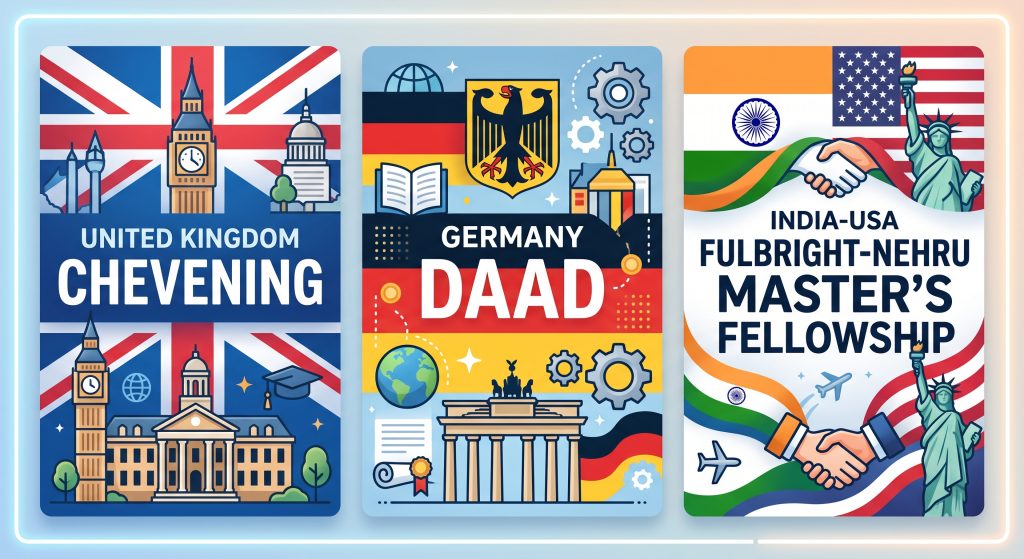
3 Governments Are Ready to Pay for Your Master’s Degree – Here’s Exactly How Each One Works https://involve-consulting.com/wp-content/uploads/2026/08/Gemini_Generated_Image_ehiuc8ehiuc8ehiu-1024x559.jpg 1024 559 Involve Consulting https://involve-consulting.com/wp-content/uploads/2026/08/Gemini_Generated_Image_ehiuc8ehiuc8ehiu-1024x559.jpgSearch “fully funded scholarship for Indian students” and you’ll land on the same three names within the first five results, every single time: Chevening, DAAD, Fulbright. You’ve probably bookmarked all three, read the eligibility pages twice, and still walked away with more questions than answers. Why do these three keep dominating every list? And more importantly, how does the money actually reach you?
Here’s the part most guides skip: these are the three biggest national government scholarship programs open to Indian students, and none of them are tied to a single university. Each one is a country deciding, as a matter of policy, that funding Indian talent abroad serves its own diplomatic and economic interests, and where you actually study is a downstream detail, not the starting point. That’s a fundamentally different animal than a business school’s internal award, and each of the three works in its own distinct way.
1. Chevening (United Kingdom)
Chevening is the UK government’s flagship global scholarship program, run by the Foreign, Commonwealth & Development Office, and India is its single largest market anywhere in the world: more than 4,000 Indian scholars funded since the program launched in 1983. It covers full financial support for a one-year master’s degree at any UK university you’re admitted to. The 2026 cohort was over 75 percent from tier 2 and tier 3 cities and 68 percent women, which tells you this isn’t a program that only rewards a narrow, elite applicant pool.
Applications for the 2027-28 cycle open August 4 and close October 6, 2026. You’ll need at least two years of work experience, and your essay needs to be about leadership and the specific impact you’ll have back in India, not why you’d enjoy your target campus.
2. DAAD (Germany)
DAAD, Germany’s federal government exchange service, runs on a two-step model that trips up a lot of applicants. You don’t apply to DAAD and a university together. You secure your own admission to a German university first, and only then apply to DAAD separately for the funding that follows you there.
For master’s students, that typically means a stipend of around 934 euros a month, plus health insurance, a travel allowance, and tuition coverage where applicable. Deadlines vary by program but mostly cluster between October and December, for an intake starting the following year, so if you’re aiming for next year, the clock is already running.
Did you know: with the Fulbright-Nehru Master’s Fellowship below, you don’t choose your own university at all. That’s a deliberate design decision, not a limitation, and it’s worth understanding before you assume every government scholarship works the same way.
3. Fulbright-Nehru Master’s Fellowship (India-US)
This is the odd one out on the list, and the most interesting one mechanically. Fulbright-Nehru is a bi-national program run jointly by the Indian and US governments through USIEF. Once you’re selected, USIEF’s placement partner, the Institute of International Education, applies on your behalf to four different US institutions chosen to match your academic profile and goals. You never submit a single university application yourself.
By removing the university-selection step entirely, the fellowship guarantees it can never become tied to one school, and puts the placement decision in the hands of people who do that matching full-time. It covers tuition and fees, living costs, round-trip economy airfare, and health and accident insurance. You’ll need at least three years of professional experience, government employees aren’t eligible, and the India cycle typically closes in mid-May each year.
Where to Actually Track These (Without 40 Browser Tabs)
Government scholarship deadlines don’t line up with each other, and they definitely don’t line up with your business school’s admissions calendar. Chevening wants your application seven to eight months before your program starts. DAAD wants an admission offer in hand before you can even apply. Fulbright-Nehru’s May deadline means you’re building your case a full year ahead of enrollment. Missing any one of these by a week usually means waiting an entire year.
That’s exactly why we built https://scholarships.involve-consulting.com/, our free database of 600-plus scholarships. Every listing is sourced directly from the funder’s own published information, whether that’s a government agency, a foundation, or a university, never scraped from a third-party site and never with a guessed deadline or amount. You can filter by your own eligibility, browse by destination or university, run the alphabetical directory if you already know what you’re hunting for, check the application calendar so nothing sneaks past you, or use our “Match me” tool to get a shortlist built around your actual profile instead of scrolling through all 600 yourself.
Your Next Steps
None of this funding is locked behind a specific school’s financial aid office. It’s sitting in national government budgets that exist specifically to bring Indian students onto campuses around the world, and the application windows for all three are open or opening right now.
If you want help mapping your profile against these three programs and building a timeline that doesn’t collide with your business school deadlines, reach out to our team at https://involve-consulting.com/contact-us/.