Admission Related

INSEAD 2026–2027 Essays: A Question-by-Question Playbook
INSEAD 2026–2027 Essays: A Question-by-Question Playbook 500 263 Involve Consulting

You open the application portal expecting the usual business school format: a resume upload, a couple of data fields, and one all-purpose personal statement about your future goals. INSEAD’s 2026–2027 cycle — covering both the January 2027 and August 2027 intakes — doesn’t work that way. Instead you find four required essays split across two very different categories, plus one optional fifth, and a combined word budget of roughly 1,700 words before you’ve written a single line of your career goals paragraph.

That structure is not an accident. INSEAD isn’t asking for a list of your professional wins. It’s testing your rationale, your self-awareness, your resilience under pressure, and your readiness for a classroom built entirely on peer-to-peer learning across cultures. Treat the essays as one connected application and you’ll waste your best material in the wrong place. Treat each one as its own, narrow test — which is what this guide walks through — and you give the admissions committee exactly what it’s grading for, question by question.

What INSEAD Is Actually Testing, at a Glance

The application splits into two Job Description essays and two required Motivation essays, with an optional fifth essay reserved for anything the rest of your application didn’t cover.

Did you know: across the four required essays, INSEAD gives you a combined limit of just 1,700 words — barely three pages — to cover your entire career rationale, your goals, your character, and a genuine crisis. That tight budget is deliberate: it forces precision over padding, which is exactly what the admissions committee is screening for.

The Job Description essays are about logic: does your career make sense, and do you know exactly where INSEAD fits in it? The Motivation essays are about character: can you be honest about a weakness, and can you stay composed when things go wrong? Every paragraph you write should serve one of those two goals — never both at once, and never neither.

Essay 1 (Job Description, 500 words): Your Career Since Graduation

The question: Provide a summary of your career since graduating from university, explaining the rationale behind your key decisions and career progression. Include a description of your current or most recent role — its scope, major responsibilities, team size, budget, clients or products, and results achieved.

What INSEAD is looking for: This is not a chronological CV recap. The admissions committee already has your resume. What they’re grading here is whether each move you made had a reason behind it — and whether that reason shows judgment, not just opportunism. A career that reads as “promotion, then bigger promotion, then bigger title” tells them nothing about how you think. A career that reads as “I took this role because I wanted to learn X, then left because I’d outgrown it and needed Y” tells them everything.

How to structure it, paragraph by paragraph:

Open with a single sentence that frames your professional identity — not your job title, but the type of problem-solver you are. Keep it to one sentence; this essay has no room for a long preamble.

In your second paragraph, cover your first one or two career moves and the specific rationale behind each — what you wanted to learn, and why the previous role couldn’t teach it to you. This is where “rationale” earns its word count: name the gap you were closing, not just the opportunity you were taking.

Your third paragraph should isolate anything that made your path international or cross-functional — a relocation, a client base spanning multiple countries, a team you managed across time zones — and treat it as its own beat rather than folding it into the general narrative. INSEAD weighs international exposure heavily, and burying it inside a sentence about your job title wastes the signal.

Your fourth paragraph is the mechanical one: current role, scope of work, direct reports if any, budget or P&L responsibility, and the results you can quantify. Be specific and be brief — this is a checklist the committee is scanning for, not a place for story-telling.

Close with one sentence bridging to INSEAD — not a generic “and that’s why I want an MBA,” but a specific line about the kind of diversity in the classroom you’re seeking next, since that’s the thread this essay has been building toward.

“I joined a renewable-energy engineering firm because I wanted exposure to physical infrastructure, not just spreadsheets — a gap my first two years in corporate finance couldn’t close. Within eighteen months I was leading commissioning for a wind-farm project that put me on-site in Brazil for six months, coordinating with three subcontractor teams who didn’t share a first language, which is where I first learned that technical accuracy means nothing if your team doesn’t trust the person delivering it. Today I manage a four-person engineering pod and a $2.1M project budget, and I closed last year having cut commissioning delays by 30% across two sites. What I’m looking for next isn’t a bigger version of this role — it’s the chance to test that judgment against peers who’ve built very different careers.”

(Illustrative example, for structure only)

Essay 2 (Job Description, 300 words): Career Goals

The question: Describe your short- and long-term career aspirations, including your target geography, industry, and function. How do you plan to bridge the gap between your current position and these goals, and how will INSEAD help you achieve them?

What INSEAD is looking for: Specificity. Vague ambition (“I want to move into a leadership role in a dynamic industry”) reads as someone who hasn’t done the thinking yet. The committee wants a named function, a named industry, and ideally a named geography — and then proof you’ve actually researched how INSEAD’s own resources close the distance between where you are and where you’re going.

How to structure it, paragraph by paragraph:

Paragraph one: your short-term goal immediately after the MBA — name the function and industry precisely, and the type of company or role you’re targeting.

Paragraph two: your long-term vision, five to ten years out — this can be more directional, but it should still connect logically to the short-term step, not read as a separate ambition bolted on.

Paragraph three: the bridge. Name specific INSEAD electives, a club, an exchange campus, or a professor’s focus area that maps directly onto the gap in your profile. Generic praise for “the diverse network” is the single most common way applicants waste this paragraph — specificity here is what separates a researched answer from a template one.

“In the short term, I want to move from engineering execution into infrastructure investment strategy, joining a fund that finances renewable projects in emerging markets. Long term, I want to run that kind of fund’s regional practice, building the financing structures that let more of these projects get built in the first place. The gap between an engineer and an investor is largely a language one — I can build the asset, but I can’t yet underwrite it — which is exactly why I’d take Understanding and Managing Risk in my first period and look to spend an exchange period at a campus with a stronger infrastructure-finance elective bench.”

(Illustrative example, for structure only)

Essay 3 (Motivation, 500 words): A Candid Description of Yourself as a Person and a Leader

The question: Give a candid description of yourself as a person and a leader, stressing the personal characteristics you feel to be your strengths and weaknesses and the main factors that have influenced your personal development, giving examples where necessary.

What INSEAD is looking for: Genuine self-awareness, not a strengths list with a fake weakness bolted on. The classic failure here is naming a “weakness” that’s actually a humble-brag — “I work too hard” or “my standards are too high.” The committee has read that essay a thousand times, and it reads as someone unwilling to do the harder work of real reflection.

How to structure it, paragraph by paragraph:

Open with the personal characteristic that has shaped you most — ideally traced back to something concrete in your early life or background, stated in a sentence or two, not a full childhood story. This sets the theme the rest of the essay will develop.

Second paragraph: describe an environment or community — a team, a program, a group you belonged to — that shaped how you lead, and name the specific leadership trait it taught you.

Third paragraph is the weakness paragraph, and it needs three things in this order: name a real weakness, describe one specific situation where it caused an actual problem for a team or project, and then explain concretely what you changed afterward. Vague weaknesses with no consequence attached don’t count as self-awareness.

Close with a short line connecting your development so far to what you still want to learn — ideally something INSEAD’s peer-learning model is specifically built to teach you.

“I’ve always been the person who checks the work twice before anyone else sees it — a habit that started in a lab environment where a missed decimal point wasn’t an inconvenience, it was a safety issue. That instinct served me well until I led a wind-farm commissioning team where my insistence on re-verifying every subcontractor’s numbers before sign-off started adding days to a schedule that couldn’t afford them. My site lead finally told me, directly, that I was optimizing for a mistake that hadn’t happened at the cost of a deadline that definitely would. I changed how I worked after that — building spot-check protocols with the team instead of redoing everyone’s math myself — and the next project came in two weeks ahead of schedule. I still default to double-checking. I’ve just learned to ask who else needs to be trusted with the check.”

(Illustrative example, for structure only)

Essay 4 (Motivation, 400 words): A Highly Stressful Situation

The question: Describe a highly stressful situation and how you managed it. What did this experience teach you about yourself and your interactions with others?

What INSEAD is looking for: Composure and reflection under real pressure — not the size of the crisis itself. A genuinely stressful situation handled with a clichéd takeaway (“I learned the importance of teamwork”) scores worse than a smaller crisis handled with a specific, honest insight about yourself.

How to structure it, paragraph by paragraph:

Set the scene in one tight paragraph — what was at stake, why it was stressful, and the timeline you were working against. Resist the urge to over-explain the background; the committee needs just enough context to feel the pressure.

Second paragraph: the actions you actually took, in the moment, including the decisions that could have gone either way. This is where composure gets demonstrated, not claimed.

Third paragraph: the outcome, and — most importantly — what it taught you about yourself and about working with others under pressure. This is the paragraph applicants rush, and it’s the one the committee is actually grading.

“Two days before a scheduled grid connection, we discovered a wiring fault that could have delayed the project by a month and cost the client a seasonal subsidy deadline. I had eighteen hours to decide whether to attempt an on-site fix with a team that had never done one under this time pressure, or to admit the deadline was gone. I chose to run the fix, but split my team into two shifts so no one was making high-stakes decisions on no sleep — a call I almost didn’t make, because it felt like it was slowing us down. It wasn’t; the second shift caught an error the first shift had missed. We made the deadline with four hours to spare. What stayed with me wasn’t the fix — it was how close I came to sacrificing judgment for speed, and how much a second, rested set of eyes matters more than raw hours worked.”

(Illustrative example, for structure only)

The Optional Fifth Essay: Use It Sparingly

INSEAD’s optional essay — “is there anything else that was not covered in your application that you would like to share with the Admissions Committee?” — is capped at 300 words and exists for exactly one purpose: genuine gaps or context the rest of your application couldn’t hold. An unusual employment gap, a test score that doesn’t reflect your ability, an academic record with a specific, explainable dip. It is not a sixth chance to talk about your achievements. If you don’t have a real gap to explain, the strongest move is to leave it blank — a forced answer here reads as padding, and padding is the one thing this application’s tight word limits were designed to filter out.

Pace This Like the Marathon It Is

With four essays sharing themes as closely as these do, the biggest risk isn’t writer’s block — it’s repetition. Before you draft a single essay, sketch out which specific story goes where, so your best leadership anecdote doesn’t get used in the 300-word career-goals essay and leave you empty-handed for the 500-word character essay. Draft in order, but review as a set: read all four back to back and ask whether together they show a well-rounded candidate, or the same three data points restated four times.

If you’re mapping your own career story across these four essays and want a second pair of eyes on which anecdote belongs where, our team at Involve Consulting can work through the structure with you — reach us here. And if funding is part of your MBA planning alongside the application itself, our verified scholarships database is a good place to start: explore scholarships.

LBS vs HEC Paris: How Do You Choose Between Europe’s Top Two Business Schools?
LBS vs HEC Paris: How Do You Choose Between Europe’s Top Two Business Schools? 1024 585 Involve Consulting

The London Hustle or the Parisian Château: How Do You Choose Between Europe’s Top Two Business Schools?

Imagine this: you refresh your inbox and there it is—an admissions offer from London Business School. A few days later, another email arrives: you’ve also been accepted to HEC Paris. For a moment, you celebrate getting into two of the world’s most prestigious business schools. Then, reality hits. You have to choose, and it won’t be easy.

On paper, these two schools look very similar. Both are consistently at the top of global rankings. Both offer unmatched access to Europe’s corporate elite. Both have alumni networks filled with Fortune 500 CEOs, prominent founders, and managing partners at top consulting firms. If you only looked at the stats, you might think flipping a coin is the only way to decide.

But choosing between London Business School and HEC Paris isn’t about comparing average starting salaries or counting library books. It’s about picking between two very different ways of living, learning, and building your career. The day-to-day experience at these schools starts to diverge the moment you arrive for orientation. Their recruiting pipelines favor different industries. Their cultural expectations demand different networking approaches. Even the campus layouts create completely different social lives during your studies.

To make the right decision, you need to look beyond the prestige and examine what each program actually offers. You need to understand how the location will shape your daily routine, how the curriculum fits your personal timeline, and what local language requirements mean for your job hunt after graduation.

The Geography of Your Network: The Metropolis vs. The Academic Village

The most immediate difference between LBS and HEC Paris is their physical location, and this geography directly affects how you’ll build your network.

London Business School is in Marylebone, right next to Regent’s Park in central London. It’s a truly urban campus. When you leave a lecture at LBS, you’re immediately in one of the world’s busiest financial and cultural centers. This means your networking is deeply tied to the city’s rhythm. You might attend a morning class, take the Tube to Mayfair for coffee with a private equity associate, and then return to campus for an afternoon group project. Corporate headquarters are just a short ride away on the Jubilee Line.

This urban integration, however, comes with a specific social dynamic. Because LBS students live across different London boroughs, the campus can sometimes feel like a commuter hub. People come for classes, club events, and the famous Thursday evening “Sundowners” networking drinks, but then they scatter back into the huge city. You have to be proactive about maintaining social ties because the city constantly pulls people in different directions.

HEC Paris offers the opposite experience. The school is in Jouy-en-Josas, a quiet suburban town about ten miles outside central Paris. The 340-acre campus is a self-contained academic village, complete with its own chateau, a lake, and extensive sports facilities. Because the campus is relatively isolated from a major city’s immediate distractions, the student experience is intensely immersive.

At HEC, you live in a bubble with your cohort. You eat, study, and socialize together on campus. This closeness creates incredibly deep, fast-forming bonds among classmates. The isolation fosters a tight-knit community where student-run events, weekend trips, and campus traditions take center stage. The most famous of these is the MBAT, an annual MBA sports tournament hosted by HEC that brings thousands of students from other top European schools to the Jouy-en-Josas campus. If you want a traditional, collegiate campus experience where your classmates are your entire world for a year and a half, HEC provides that in a way a city school simply can’t.

Curriculum Structure: Flexible Timelines vs. Phased Specialization

The academic structure of both schools caters to different pacing needs.

London Business School is known for its highly flexible MBA timeline. You can choose to finish the program in 15, 18, or 21 months. This flexibility is a huge advantage depending on your career goals. If your current employer sponsors you and you need to return to your job quickly, the 15-month track gets you back into the workforce with minimal opportunity cost. If you’re changing careers and need time for a summer internship, to build a new network, and perhaps even take on a term-time internship during your second year, the 21-month track gives you the time to make that pivot successfully. You control the pace.

HEC Paris uses a standard 16-month timeline for its MBA, split into two distinct eight-month phases. The first half is the Fundamental Phase, where you follow a rigorous core curriculum with your study group. The second half is the Customized Phase, where the program opens up completely. During this second phase, you can pursue specific specializations, take on a fieldwork project, go on an international exchange, or focus heavily on an entrepreneurial venture. This 16-month duration is often seen as the “sweet spot” for European MBAs. It’s long enough for a summer internship and a proper academic deep dive, but short enough to keep your time out of the workforce relatively brief.

Industry Pipelines: Where the Alumni Actually Go

Both schools will tell you their graduates succeed in every industry imaginable. While technically true, on-campus recruiting tells a more specialized story.

London Business School is Europe’s undisputed leader in finance. If you aim for investment banking, private equity, venture capital, or asset management in London, LBS is the top target school. Major financial institutions have deep, established recruiting pipelines directly into the LBS campus. The finance faculty includes leading practitioners, and the student-run finance clubs are highly organized to prepare you for rigorous technical interviews. Beyond finance, LBS is exceptionally strong at placing candidates into the London offices of top-tier strategy consulting firms and large technology companies.

HEC Paris, on the other hand, has a unique and strong hold on the luxury, retail, and cosmetics sectors. Given its proximity to Paris, the global capital of luxury, HEC has unmatched ties to conglomerates like LVMH, Kering, and L’Oréal. The school even offers a dedicated Luxury Certificate program sponsored by Kering. If you want to manage a heritage fashion brand or work in luxury strategy, HEC is arguably the best business school in the world for that specific path.

Additionally, HEC has built a strong reputation in entrepreneurship. The school places a huge emphasis on innovation and supports students who want to launch their own ventures right after graduation.

Did you know: HEC Paris students have direct access to Station F, the world’s largest startup facility in central Paris, where the school maintains its own dedicated incubator space to house and fund student-led companies.

It’s worth noting that both schools are powerhouses for strategy consulting. Whether you attend LBS or HEC, you’ll have every opportunity to interview with McKinsey, Bain, and Boston Consulting Group. The difference usually comes down to geography. LBS will primarily feed into the London offices of these firms, while HEC will feed heavily into the Paris offices, as well as other major hubs across continental Europe and the Middle East.

The Master in Management Factor: Early Career Prestige

While the MBA programs get the most public attention, both schools also offer world-class Master in Management degrees for early-career professionals. However, the cultural weight of these MiM programs differs significantly between the UK and France.

In France, the MiM is known as the “Grande École” program, and it represents the pinnacle of the French higher education system. HEC Paris was founded on its Grande École program long before it offered an MBA. In the French corporate world, an HEC MiM degree carries an almost mythical level of prestige. It’s the traditional training ground for the country’s CEOs, politicians, and industry leaders. The program is highly academic, deeply rigorous, and heavily integrated into the continental European job market. If you’re an early-career applicant looking to build a long-term career in Europe, the HEC MiM offers a level of historical prestige that’s hard to match.

London Business School’s MiM is a different kind of tool. It’s a fast-paced, one-year accelerator designed to make recent graduates immediately employable in the competitive London job market. It doesn’t have the centuries-old cultural mythology of the French Grande École system, but it makes up for that with sheer practical impact. The LBS MiM uses the same corporate relationships, faculty, and London location as the MBA program. It’s a pragmatic, results-oriented degree designed to help you secure an analyst role in consulting, finance, or tech as quickly as possible.

The Realities of Language and Work Visas

This is often the deciding factor for international applicants, and it requires an honest self-assessment. You must consider the language you speak and the visa regulations of the country where you plan to work.

If you attend London Business School, the language of the classroom, campus, and city is English. You can recruit for jobs in London, network with alumni, and build a life in the UK without needing to learn a second language. Plus, the UK currently offers a Graduate Route visa, which allows international students to stay and work in the UK for a period after graduation, providing a clear path to secure employment without needing immediate corporate sponsorship.

HEC Paris presents a different linguistic reality. Yes, the MBA and MiM programs are taught entirely in English. You can easily get by on the Jouy-en-Josas campus and make friends from all over the world using only English. However, if your goal is to stay in France and work in Paris after graduation, not speaking French will be a significant barrier. While some large multinational companies in Paris operate in English, most local roles in consulting, finance, and corporate strategy require business-level French fluency.

If you don’t speak French and don’t plan to learn it to a professional standard, attending HEC Paris means you’ll likely need to recruit for roles outside of France. Many HEC graduates do exactly this, securing roles in London, Amsterdam, Berlin, or Dubai. The HEC brand is strong enough to carry you across borders, but you must be prepared for a cross-border job hunt. France also offers favorable post-study work visas for graduates of its master’s programs, but a visa is only useful if you can pass a job interview in the local language.

Decoding the Application and Interview Process

Because these schools look for slightly different profiles to fit their distinct cultures, their application and interview processes reflect those differences. Understanding what the admissions committees value is crucial for deciding where you might be a better fit.

London Business School places a high value on global perspective and collaborative leadership. They want to see that you can thrive in a diverse, fast-paced environment. LBS application essays typically ask you to clearly articulate a pragmatic career vision and explain exactly how their specific program and the London location will help you achieve it.

The LBS interview process is famously conducted by alumni. These interviews are usually conversational but very thorough. Alumni evaluate you on a practical metric: they ask themselves if they would want you on their team, if they would introduce you to their boss, and if you have the polish to represent the LBS brand in the London corporate world. You need to show strong interpersonal skills, a clear understanding of your target industry, and genuine enthusiasm for the LBS community.

HEC Paris takes a slightly more academic and structured approach to admissions. They value intellectual curiosity, international exposure, and a clear reason for wanting to study in France. The HEC application requires a series of shorter essays that test your ability to think critically about your career, your values, and your leadership style.

The HEC interview process is unique among top business schools. If you’re invited to interview, you’ll meet with two different alumni separately. For each interview, you must prepare a ten-minute presentation on a topic of your choice. This topic can be anything from a professional project you managed to a personal hobby you’re passionate about. The presentation is followed by a standard interview. This format tests your communication skills, your ability to structure a narrative, and your capacity to engage an audience. It’s a concrete test of your executive presence.

Making the Final Decision

When you strip away the rankings and prestige, the choice between London Business School and HEC Paris comes down to a few concrete questions.

Do you want to live in the center of a global financial metropolis, or do you want the immersive, community-focused experience of a dedicated academic campus? Do you need the flexibility to extend your studies to 21 months, or does a structured 16-month program fit your timeline better? Are you focused on London finance, or are you drawn to the luxury sector and the European startup ecosystem? Finally, are you prepared to navigate the linguistic realities of the French job market, or do you need an English-speaking professional environment?

There’s no wrong choice here, only the choice that aligns with your specific career goals and personal working style. Both schools will give you a world-class education and a global network. Your job is simply to decide which environment will best support the future you want to build.

If you’re ready to explore which of these top European programs is the right fit for you, or need help crafting an application that truly stands out, get in touch with us today.

Top MBAs without GMAT/GRE requirement
Top MBAs without GMAT/GRE requirement 1024 558 Involve Consulting

Are you feeling the pressure of those daunting MBA entrance exams? Let’s explore the GMAT dilemma.

The GMAT Dilemma: Do You Really Need It for a World-Class MBA?

For many aspiring MBA candidates, the thought of the Graduate Management Admission Test (GMAT) looms large, often seen as an inescapable hurdle to accessing elite business schools. It’s a significant investment of time, money, and mental energy. But is it truly indispensable for securing a place in a top-tier MBA programme? This question presents a considerable dilemma for countless applicants worldwide: to embark on the rigorous GMAT preparation journey or to seek alternative paths.

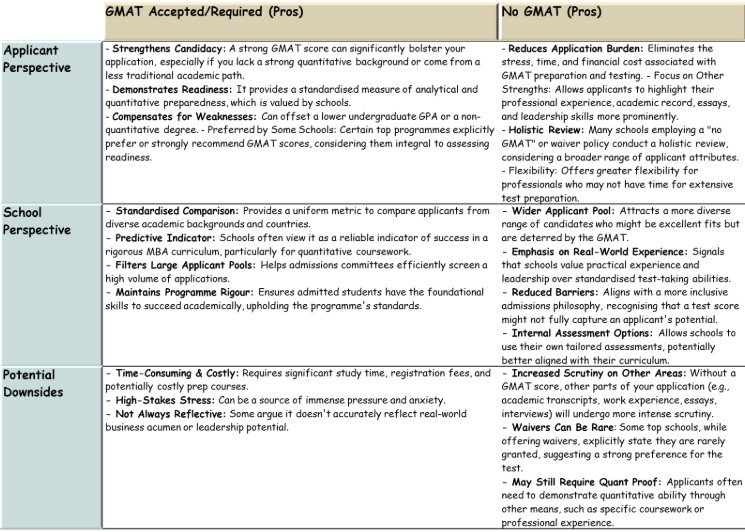
Let’s weigh up the pros and cons of taking the GMAT versus exploring options that don’t require it:


GMAT vs No GMAT Pros and Cons Table

Click here to know why colleges are looking for GMAT in detail

The Good News: Top MBAs Without the GMAT are a Reality!

Despite the common perception, many world-class MBA programs now offer pathways for admission without a GMAT score. This is excellent news for candidates who excel in other areas or who find standardised testing a significant barrier. Generally, there are three main avenues to consider:

A. Take the College’s Own Test

Some institutions, particularly in Europe and Asia, have developed their own bespoke admissions tests. These tests are often designed to assess skills relevant to their specific program and can be a fantastic alternative.

Europe (Spain)

  • ✓IE Business School: Offers the ieGAT.
  • ✓ESADE Business School: Provides its ESADE admission test.
  • ✓EADA Business School Barcelona: Uses the EADA admission test.

Europe (Italy, Germany, France)

  • ✓ESCP Italy Campus: Offers an in-house ESCP test.
  • ✓HHL Leipzig Graduate School of Management: Has an in-house test.
  • ✓IESEG School of Management: GMAT/GRE optional, with an own test possible.

Asia (South Korea)

  • ✓POSTECH Business School: Allows its school’s own test.
  • ✓Ulsan National Institute of Science & Tech: Uses a school’s test.
  • ✓Sogang University Graduate School of Business: Offers school’s own test as an option.

B. Apply for a Waiver

Many leading MBA programs now operate a test-optional policy or offer GMAT/GRE waivers for candidates who can demonstrate strong quantitative and analytical abilities through other aspects of their application.

United States

  • ✓MIT Sloan
  • ✓UCLA Anderson
  • ✓University of Michigan (Ross)
  • ✓Georgetown McDonough
  • ✓Georgia Tech (Scheller)

United Kingdom, Canada, Australia, France

  • ✓Imperial College London
  • ✓Ivey Business School (Western)
  • ✓University of Sydney Business School
  • ✓NEOMA Business School

C. College Does Not Need GMAT at All

A growing number of reputable business schools have moved away from requiring the GMAT altogether, adopting policies that prioritise a more holistic review of an applicant’s profile.

United States

  • ✓Washington Foster
  • ✓Rochester (Simon)
  • ✓Babson College (Olin)

United Kingdom

  • ✓Durham University
  • ✓Lancaster University Management School
  • ✓University of Birmingham, Bath, and Leeds

France, Germany, Australia, South Korea

  • ✓SKEMA Business School
  • ✓Berlin School of Economics and Law
  • ✓Deakin University
  • ✓Ewha Womans University School of Business

Refer to our Beyond GMAT guides for more information:

A Hard Choice? We Understand.

Deciding whether to take the GMAT can feel overwhelming. It’s a strategic decision that depends on your individual profile, career goals, and the specific programs you are targeting. We have helped hundreds of MBA candidates navigate this same uncertainty and get into top B-Schools, with or without the GMAT.

For personalised guidance, detailed insights, and assistance with your MBA strategy, please do not hesitate to contact us.

Choosing the Right Courses and Colleges
Choosing the Right Courses and Colleges 1024 536 Involve Consulting

One of the most crucial aspects of studying abroad is selecting the right courses and colleges that align with your academic aspirations and career goals. Admission consultants have extensive experience working with students from various backgrounds, making them well-equipped to advise you on suitable programs and universities that will meet your specific needs. They can provide valuable information about the different majors, faculty, research opportunities, and campus culture, empowering you to make an informed decision that will shape your educational journey.