
France vs Spain: Where Masters Scholarship Money Goes Further
France vs Spain: Where Masters Scholarship Money Goes Further https://involve-consulting.com/wp-content/uploads/2026/09/france-vs-spain-masters-scholarships-1024x538.png 1024 538 Involve Consulting https://involve-consulting.com/wp-content/uploads/2026/09/france-vs-spain-masters-scholarships-1024x538.pngMost international students size up Paris and Madrid on rent, cafés and post-study visa rules. The bigger financial gap sits somewhere less obvious: institutional aid.
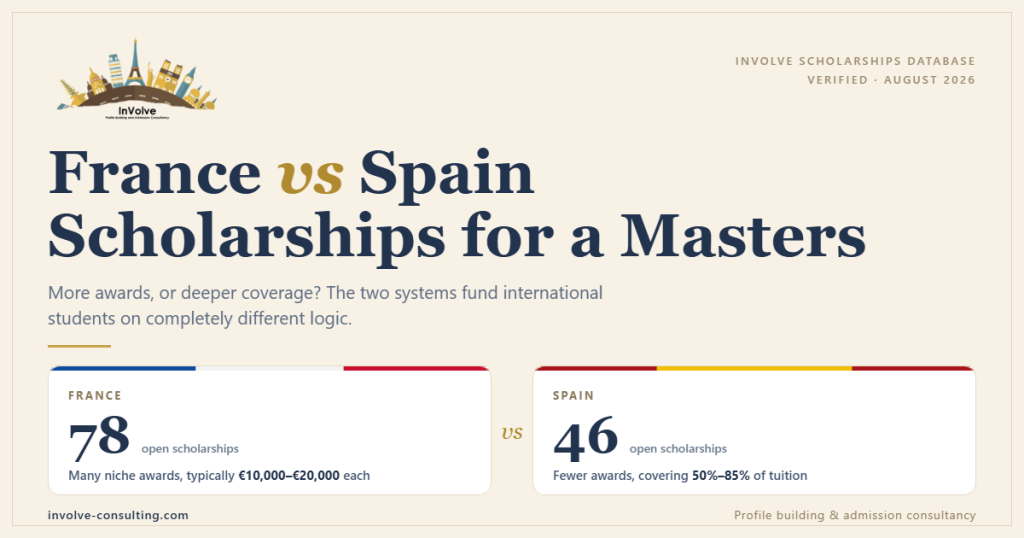
Our 16 August 2026 export from the Involve Scholarships database shows 78 open scholarships for international business students in France, against 46 in Spain. Read quickly, 78 versus 46 makes France the obvious winner. Read properly, it does not. France hands out a lot of mid-sized, tightly defined awards. Spain hands out fewer, and several of them wipe out most of a tuition bill. Which country stretches your money further depends on whether your profile is unusual or your financial need is documented.
Don’t judge a country by its sticker price
Applicants to a Masters in Management or an MSc usually compare tuition and cost of living, notice that a room in Barcelona costs less than one in the 6th arrondissement, and conclude that Spain is the cheaper degree. That comparison misses where the real money moves.
As an international student, your funding options are narrow. The subsidised state loans local EU students use are not open to you. You are left with savings, a private international student loan at an unfriendly rate, or a scholarship from the school itself. Scholarships are the only one of those you never pay back, so the way French and Spanish institutions hand out grants will shape your final cost far more than the price of a metro pass.
The point is not that business school is expensive. It is that the two countries discount tuition on different logic. Apply into a system that is not built for your profile and you leave several thousand euros behind.
Some systems spread aid thinly across many students to build a mixed classroom. Others concentrate endowment money into a handful of large grants aimed at candidates who genuinely cannot pay. Knowing which one you are applying into is how you predict your actual outlay.
France: many awards, each with a ceiling
France simply has more grants available. Across those 78 verified open scholarships, French business schools have spent the past two decades building narrow funding pools rather than a few large general ones.
The goal is a cohort that reads like a UN General Assembly: every professional background, every nationality, every gender. To get there, schools carve out separate awards for candidates from specific emerging markets, for women moving into finance, for people arriving from industries that rarely send anyone to business school, and for particular leadership profiles. The average award is a fixed sum rather than a full ride, but if your background is distinct, your odds of landing at least one of them are good.
The INSEAD Diversity Fund Scholarships are a fair example. INSEAD uses the fund to keep a wide mix of nationalities and career histories in each intake, and it pays a partial tuition grant of €10,000 to €20,000. The deadline is 22 October 2026.
Sciences Po’s Émile Boutmy Scholarship works the same way for Masters candidates from outside the European Union, offering an €18,500 tuition exemption. That one closes on 19 October 2026.
Neither covers the full cost of attendance. Both give you a predictable, fixed discount that brings the degree within reach for a targeted set of international profiles.
Worth knowing: the Émile Boutmy Scholarship is aimed squarely at strong non-EU applicants, which makes its €18,500 exemption one of the largest single non-EU awards currently open anywhere in the French system.
Spain: fewer awards, but they go deep
Spain runs the opposite play. Its 46 verified open scholarships are fewer in number, and considerably heavier per student. Spanish business schools tend to pool their aid into broader categories and weight demonstrable financial need alongside academic record.
Rather than fifty separate €10,000 awards tied to nationality or industry, Spanish institutions are more likely to fund a large percentage of your tuition bill outright. Win one and the effect on your finances is not incremental. The catch is that you are competing in a smaller, more general pool, which makes the initial decision harder to win.
Esade Business School shows the model clearly. Instead of capping aid at a flat euro figure, it ties the award to the cost of the programme. The Esade MSc Need-based Scholarships cover between 50% and 85% of total tuition fees. The exact deadline for that MSc grant is not published, but the structure is a permanent feature of how the school funds students, not a one-off call.
The same applies on the MBA side, where the Esade Need-based Scholarships for the Full Time MBA also run at 50% to 85% of tuition during the 2026-2027 call. On a €70,000 bill, an 85% award does more for your debt than two French diversity grants stacked together.
Reading the two systems side by side
| France | Spain | |
|---|---|---|
| Open scholarships (Aug 2026) | 78 | 46 |
| Typical structure | Fixed euro amount | Percentage of tuition |
| Award logic | Diversity and profile fit | Financial need plus merit |
| Typical range | €10,000 – €20,000 | 50% – 85% of tuition |
| Odds vs. size | Better odds, smaller cheques | Longer odds, bigger cheques |
| Best suited to | A distinctive or underrepresented profile | Documented need with strong academics |
So which one suits you
You cannot decide this on a general sense of which country feels cheaper. It comes down to one honest question: is your background unusual, or is your need documented?
If you come from an underrepresented region, hold a demographic profile schools are actively recruiting, or work in an industry that rarely feeds into a Masters in Management, France will usually stretch further. With 78 awards in circulation, you can aim at the specific pots built for someone like you. You are playing the odds, and the odds are decent, because French schools have already earmarked money to make sure a candidate with your profile is sitting in the room.
If your background is more conventional but you can evidence real financial need alongside strong academic results, Spain will usually stretch further. There is no niche fund to hunt for. You apply straight into the broad need-based grants at schools like Esade and aim at that 50% to 85% reduction. You are playing for depth, backed by a system that heavily subsidises a small number of candidates who cannot meet the sticker price.
Stop guessing which country is more affordable. Look at your CV, look at your bank statement, and match the two against how each country actually hands out money.
If you would rather build a funding strategy than guess at one, Involve Consulting can help. We work with international applicants to pin down the programmes and institutional grants that fit their professional background and their financial reality. Tell us about your profile at involve-consulting.com/contact-us.
To see the deadlines, coverage and eligibility behind all 124 scholarships across France and Spain, browse the verified database at scholarships.involve-consulting.com.